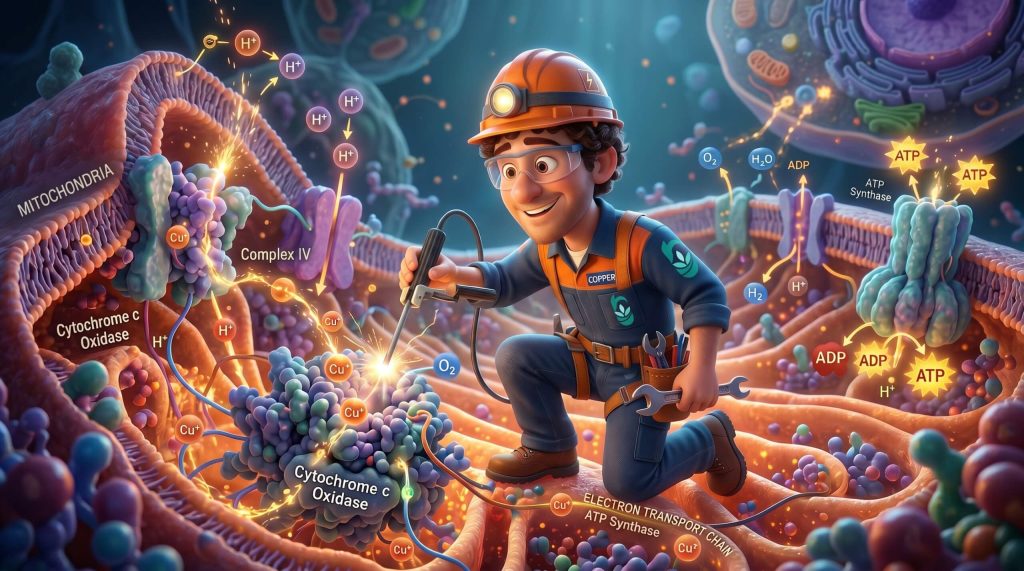

Magnesium is the core element for energy production and physical performance. It is highly concentrated in skeletal muscle and the heart, where metabolic demand is highest. During physical exertion, the body’s requirement for magnesium increases by an estimated 10% to 20% due to its role in energy production, oxygen transport, and the maintenance of the sodium-potassium balance across cell membranes.
1- The Mg-ATP Complex and Mitochondrial Function
The most critical role of magnesium in exercise is its relationship with Adenosine Triphosphate (ATP), the primary energy currency of the cell. ATP is biologically inactive unless it is bound to a magnesium ion. This forms a complex known as Mg-ATP.
Magnesium is required for the breakdown of ATP bonds releasing the energy stored in these bonds to fuel muscle contraction or protein synthesis. A deficiency in magnesium leads to suboptimal mitochondrial respiration (the process of energy molecules production), resulting in decreased maximum oxygen uptake and early muscular fatigue.
2- Glycolysis and Lactic Acid Clearance
Magnesium plays a rate-limiting role in glycolysis, the process by which the body breaks down glucose for energy during high-intensity, anaerobic exercise.
Beyond production, magnesium is also vital for the clearance of metabolic waste. It facilitates the transport of glucose into the muscles and aids in the buffering and removal of lactate (lactic acid). Clinical observations indicate that athletes with low magnesium status exhibit higher levels of blood lactate and increased heart rates during submaximal exercise, suggesting that the body is working significantly harder to maintain the same level of output.
3- Neuromuscular Transmission and the Ca/Mg Balance
Muscular contraction and relaxation are governed by a delicate interplay between calcium and magnesium. Calcium is the excitatory mineral, its release into the muscle cell triggers a contraction. Magnesium is the relaxing mineral, it competes with calcium for binding sites and actively pumps calcium back into storage after the contraction is finished.
When magnesium levels are insufficient, calcium remains in the muscle fiber for too long, leading to sustained tension or involuntary contractions. This is the physiological basis for exercise-associated muscle cramps, and tremors.
4- Recovery and Electrolyte Homeostasis
Post-exercise recovery depends on the restoration of the sodium-potassium pump, which resets the electrical charge of the muscle cells. This pump is strictly magnesium-dependent. Without adequate magnesium, the pump fails to operate efficiently, leading to prolonged muscle soreness and delayed recovery.
For the athlete, maintaining a high magnesium status is not merely about performance boosting, but about preventing the systemic breakdown of muscular and mitochondrial efficiency.
Scientific resources
Nielsen, F. H., & Lukaski, H. C. (2006). Update on the relationship between magnesium and exercise. Magnesium Research, 19(3), 180–189.
Zhang, Y., et al. (2017). Can Magnesium Supplementation Enhance Exercise Performance? Nutrients, 9(9), 946.
Pollock, N., et al. (2020). The importance of magnesium in the athlete. International Journal of Sport Nutrition and Exercise Metabolism.