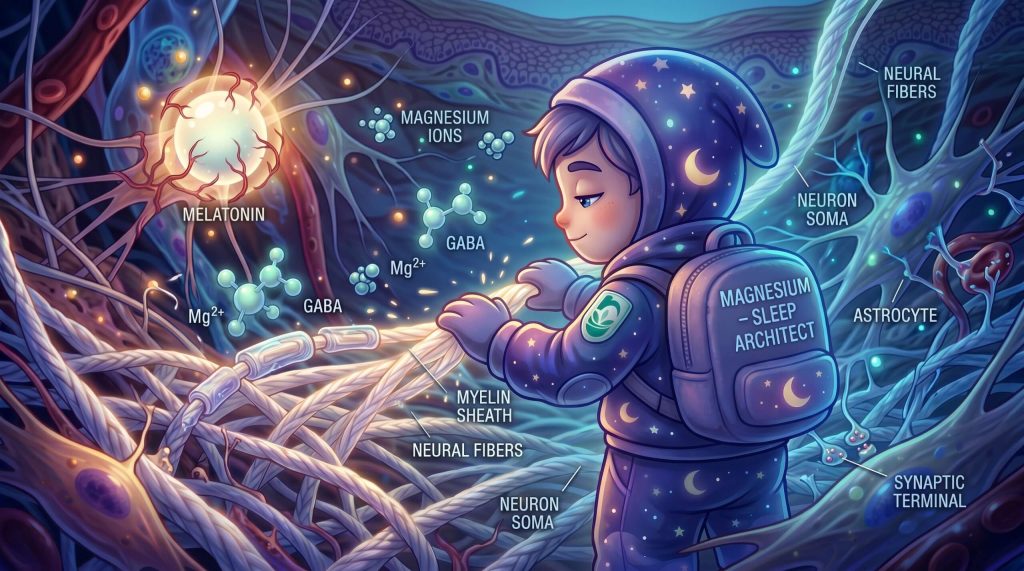
Sleep is a highly regulated physiological state that requires the central nervous system to shift from a state of arousal to a state of rest. Magnesium is the primary mineral that facilitates this transition through its interaction with the GABAergic system and its regulation of the body’s internal circadian clock.
1. GABAergic Agonism and Neuronal Quelling
Gamma-Aminobutyric Acid (GABA) is the brain’s primary inhibitory neurotransmitter. Its role is to reduce the activity of neurons, effectively slowing down the brain’s electrical activity. Magnesium is a direct activator for GABA receptors, it binds to these receptors and enhances their sensitivity.
This interaction is critical for sleep onset (falling asleep). By increasing GABAergic tone, magnesium helps the brain move away from active thought state and into the slower relaxation and early sleep mood. In patients with chronic insomnia, magnesium supplementation has been shown to reduce the time it takes to fall asleep (sleep latency) and improve the overall efficiency of sleep.
2. Regulation of the Circadian Rhythm and Melatonin
The sleep-wake cycle is governed by the hormone melatonin, which is produced in the pineal gland. The synthesis of melatonin from its precursor, serotonin, requires the presence of several enzymes, many of which are magnesium dependent.
Furthermore, magnesium is involved in the regulation of the Suprachiasmatic Nucleus, the master clock in the brain. Magnesium levels fluctuate in a circadian pattern within our cells, helping to synchronize our internal biological processes with the 24-hour day-night cycle. A lack of magnesium can lead to a de-syncing of this clock, manifesting as fragmented sleep or waking up too early.
3. Thermoregulation and Cortisol Suppression
For the body to enter a deep sleep, the core body temperature must drop slightly. Magnesium facilitates this through peripheral vasodilation, widening the blood vessels to allow heat to escape through the skin.
Additionally, magnesium suppresses the release of cortisol. Cortisol is an arousal hormone that naturally peaks in the morning to wake us up. If cortisol remains high at night (often due to stress), it overrides the signals for sleep. Magnesium helps “blunt” this nighttime cortisol spike, ensuring that the body stays in a restful state throughout the night. This leads to a higher percentage of Slow Wave Sleep (Deep Sleep), which is the most restorative phase for physical and cognitive repair.
Scientific resources
- Abbasi, B., et al. (2012). The effect of magnesium supplementation on primary insomnia in elderly: A double-blind placebo-controlled clinical trial. Journal of Research in Medical Sciences, 17(12), 1161–1169.
- Durlach, J., et al. (2002). Biorhythms and magnesium with special reference to health and disease. Magnesium Research, 15(3-4), 203–215.
- Wienecke, E., & Nolden, C. (2016). Long-term HRV analysis shows stress reduction by magnesium intake. MMW Fortschritte der Medizin, 158(Suppl 6), 12–16.